Showing posts with label science of climate change. Show all posts

Monday, August 23, 2010

Climate Change: Attacking Science and Scientists

Never one to look at the science that OPPOSES his big push on man-made global warming, former VP Al Gore continues to whine and blame everybody else (the U.S. Senate, the right-wing media, "professional deniers") for the fact that not ALL science backs up his bizarre beliefs. He says, "The battle is not over."

Oh really?


Gore Concedes on Climate This Year

Speaking about the likelihood of climate bill being passed by Congress in 2010, Al Gore told a conference call of supporters tonight that, “this battle has not been successful and is pretty much over for this year.” Gore bitterly denounced the Senate and federal government stating several times, “The U.S. Senate has failed us” and “The federal government has failed us.” Gore even seemed to blame President Obama by emphasizing that “the government as a whole has failed us… although the House did its job. [emphasis added]”

Gored urged his listeners to take the “realistic view that they had failed badly.” Gore said that “Comprehensive legislation is not likely to be debated” and that a “lame duck debate” is a “very slim possibility indeed.” (N.B. We thought, because Gore told us, that “the debate” was over.)

Gore said “the government was not working “as our founders intended it to” and laid more blame at the feet of fossil fuel interests who conducted a “cynical coordinated campaign” with “unprecedented funding” and “who have spent hundreds of millions of dollars just on lobbying.” He criticized “polluters” for “dumping global warming pollution into the atmosphere like it was an open sewer.”

Gore blamed the skeptics for “attacking science and scientists.” “They [the skeptics] did damage and cast doubt,” Gore said.

Asked why the alarmists were ineffective in addressing Climategate, Gore bitterly blamed a “biased right-wing media… bolstered by professional deniers.” Gore claimed the Wall Street Journal published 30 editorial and news articles about Climategate and “not a single one presented [his] side of the science.”

Speaking about the post-2010 prospects for a climate bill, Gore tried to boost morale by stating that “the battle is not over” and that “we [alarmists] have no choice but to win the battle.” Gore said that “reality is [the alarmists] ally” and then, among other things, blamed recent flooding in Nashville and the Russian heatwave/forest fires on global warming.

He concluded by observing that “it is darkest before dawn” and “we have not yet begun to fight.”

In a warm-up discussion before Gore addressed the call, National Wildlife Federation chief Larry Schweiger referred to the skeptics as “enemies” and that he hoped the alarmists would “outlive the bastards.”


Steve Milloy publishes JunkScience.com and is the author of Green Hell: How Environmentalists Plan to Control Your Life and What You Can Do to Stop Them (Regnery 2009).

Thursday, July 15, 2010

The U.S. Constitution, Global Warming, Environmental Protection

In order to discuss the role that the U.S. Constitution plays in determining the appropriate course of action regarding global warming and environmental protection, CARE has turned to former U.S. Senator (Represented New Mexico) and Apollo astronaut Harrison H. Schmitt. Our contributing writer uses his expertise as a former geologist to build the case that carbon dioxide is NOT the cause of an impending global warming disaster. Quite the contrary, his data-driven analysis strongly suggests that the greenhouse gas effect aids humanity by making the planet more habitable rather than less habitable. At one point he states that "All we really know at present is that natural variations in climate have been very complex, often extreme, and all before human industrial activity existed."

After considering the science behind climate variation, Senator Schmitt points out that local/state environmental challenges rather than global environmental degradation should become the focus of concerned citizens within the context of the 2010 election. The best way to achieve this is to apply the interstate commerce clause to environmental challenges and to resist attempts to erode constitutional liberties in the name of environmental ideology. This is an ideal read for those that wish to link sound science with meaningful public policy reforms.

Climate (Temperature) and the Constitution #3

Ten thousand years of natural, post-Ice Age climate variability should give pause to those who maintain that current slow global warming and carbon dioxide increases result largely from human use of fossil fuels. Public confidence in that position also suffers from the exposure of fraudulent academic and bureaucratic behavior aimed at overriding normal processes of skeptical scientific review and debate.

Observational data and interpretations related to global temperature and atmospheric carbon dioxide deserve close examination before taking irrevocable and dangerous regulatory actions. If there were no other factors affecting temperature at the Earth¹s surface, the balance between heat from the sun and heat re-radiated from the Earth to space would give an average surface temperature of about zero degrees Fahrenheit (-18 degrees Centigrade). Not good. Fortunately, natural greenhouse heat trapping effects of atmospheric water and to a much lesser extent carbon dioxide and methane, add about 146 thermal watts per square meter (versus the Sun¹s irradiance of 1366 watts per square meter) so that the average surface temperature of the Earth becomes about 59 degrees Fahrenheit (15 degrees Centigrade), making the planet habitable rather than being a ball of ice covered rock and water with occasional volcanic eruptions.

Geological investigations indicate that over the last 600 million years average global surface temperature appears to have been buffered roughly at a maximum of about 72 degrees Fahrenheit (22 degrees Centigrade). The last 53 million years being significantly colder than the previous average, as indicated by oxygen isotopes of shells in sea floor cores, but comparable to other cold periods in the geologic past. During this 600 million year period, major cold perturbations to about 54 degrees Fahrenheit (12 degrees C) occurred about every 150 million years. Over that period, carbon dioxide decreased from an estimated maximum of about 7000ppm 550 million years ago to minimum of about 300ppm around 300 million years ago (current level at 385ppm) without changing the long-term average temperature at the Earth¹s surface.

Around 43 million years ago, declining carbon dioxide concentration reached about 1400ppm, followed by three oscillations during the next 10 million years with amplitudes of about 1000ppm. Temperature apparently remained relatively constant during these ancient carbon dioxide oscillations except during the most recent when oxygen isotope ratios indicate a sharp drop in temperature 33.5 million years ago, that is, about the time ice sheets began to accumulate on Antarctica. Relative to today¹s values, declining atmospheric carbon dioxide levels remained relatively high (740-1400ppm) as Antarctica cooled.

About 22 million years ago, with its continued slow migration away from Africa, Australia, and South America, the ocean distribution and ocean currents around Antarctica began to resemble modern configurations, with partial deglaciation of that continent beginning about 14-15 million years ago. A particularly warm two million years for the tropical Earth latitudes developed about 4 million years ago even as sea surface temperatures slowly declined toward present levels. This seemingly contradictory situation apparently related to a long-term north-south expansion of the warm tropical ocean waters resulting in a factor of four reduction in the sea surface temperature gradient from the equator to at least 34ºN (~2ºC gradient versus ~8ºC, today) that lasted until about 1.5 million years ago. Along with disruptions of the El Niño Southern Oscillation, convective tropical Hadley circulation apparently slowed during this long period with both effects probably leading to significant global climate impacts.

About 2.75 million years ago, major ice ages began to oscillate with periods of warmth (interglacials). This occurred in spite of the concurrent anomaly in the tropical sea surface temperature gradient. Ten specific high latitude ice ages took place in the last million years, apparently correlated with a change in the dominant solar influence on cooling from the Earth's 41,000-year orbital obliquity cycle to its 100,000-year eccentricity cycle. A significant decrease in the overall concentration of atmospheric carbon dioxide occurred at about the same time as this change in orbital influence with even greater, temporary reductions associated with each ice age; however, the reported data do not support a causal association of this decrease in carbon dioxide with the overall cooling during this million-year period.

Terminations of past ice ages appear to be associated with increased solar heating (insolation), as orbital influences changed, and not with triggering increases in carbon dioxide levels; although such increases certainly accompanied the terminations. Recent suggestions that increase in atmospheric carbon dioxide forced temperature changes and ice age terminations over the last 20 million years or so suffer from science¹s inability to adequately time-correlate changes in carbon dioxide levels with changes in global temperature, i.e., correlation does not, by itself, mean causation. As carbon dioxide release from the oceans due to warming lags warming by hundreds to thousands of years, no support exists for a conclusion that a specific natural carbon dioxide change forced a specific temperature change.

The lesson in these variations in values for atmospheric carbon dioxide and global temperature through geologic time, at least at a million-year or so time-resolution, appears to be that increases and decreases in carbon dioxide have not triggered global temperature changes as derived from fossil oxygen isotope ratios. Other long-term geological and solar-related phenomena may have overwhelmed any broad greenhouse effects related to carbon dioxide; or, alternatively, the proxies used for estimating ancient atmospheric carbon dioxide concentrations may be invalid. All we really know at present is that natural variations in climate have been very complex, often extreme, and all before human industrial activity existed.

Studies of Antarctic ice cores indicate that Earth-surface temperatures several degrees warmer than present existed during the four preceding interglacials of the last 420,000 years. At a low time-resolution of 1000s of years, carbon dioxide in the atmosphere apparently did not rise above 290ppm (compared to 385ppm today), and its changes would appear to be correlated directly with temperature changes. On the other hand, high time-resolution ice core data indicates that both increases and decreases in atmospheric carbon dioxide lag associated increases and decreases in global temperature by hundreds to a thousand years for major long-term temperature variations. The rise or fall in average ocean temperature would be expected proceed any effect on stored carbon dioxide due to the oceans¹ relatively high mass and slow circulation.

A particularly prolonged warm period in the current interglacial between 9000 and 6000 years ago has been documented, most recently in oxygen isotopic analyses of Greenland ice sheet cores. That warm period resulted in significant thinning of Greenland¹s ice sheet to thicknesses within a 100m of those of today. Several other warm periods have occurred since, the most pronounced of which has been termed the Medieval Warm Period (500-1300).

Warm periods, sometimes referred to as "climate anomalies," of this nature were largely highly beneficial to fledgling human cultures.

After a century-long transition from the Medieval Warm Period, the Little Ice Age of 1400-1900 recorded the most recent interval of significant global cooling. Global cooling characterized the Little Ice Age in most regions, accompanied in some areas by droughts. By 1400, however, Artic ice pack had enclosed Iceland and Greenland and driven Viking settlers away from their farms on those islands. By the end of the 1600s, in response to the continued climate cooling, glaciers had advanced over valley farmlands cultivated as those same glaciers receded during the Medieval Warm Period.

Indeed, essentially all of the consequences of warming prior to 1300 reversed during the next several hundred years of the Little Ice Age.

Since about 1660, gradual global warming of about 0.9 degree Fahrenheit (0.5 degree Centigrade) each 100 years has occurred, although decades-long cooling events have interrupted this trend. Antarctic sea ice, however, now has been expanding northward for about two decades after indications in the Law Dome ice core of an additional gradual decline between about 1960 and 1990.

Although the observational, historical, and geological evidence indicates strongly that global scale changes in the climate, ocean chemistry, and biological activity have roots in natural processes, the concentration of human pollution in local areas of the Earth have documented adverse impacts.

It remains increasingly in the economic and societal interests of the private sector and State governments to stop and reverse the unnatural changes for which they bear constitutional responsibility.

Private sector, State, and Federal control of their contributions to regional local pollution effects, and consumer, shareholder, and voter insistence on prevention and cleanup, form an integral part of the nation¹s future. Appropriate and restrained Federal regulation within the Founders¹ logically constrained intent of Article I, Section 8, Clause 3, of the Constitution, that is, the Commerce Clause, can contribute greatly to the instigation of this new environmental ethic.

On the other hand, unconstitutional coercion will make matters worse while at the same time eroding essential liberties. The long road back to constitutional protection of the environment begins with the elections of 2010.

*****

Harrison H. Schmitt is a former United States Senator from New Mexico as well as a geologist and former Apollo Astronaut. He currently is an aerospace and private enterprise consultant and a member of the new Committee of Correspondence

Thursday, December 10, 2009

Climategate's Lesson: Science Hasn’t Failed, Government Has

The recent revelations of the "Climategate" scandal raises concerns about the integirty of government and science in energy-related matters, so CARE decided to enlist the aid of Patrick Cox, a transformative technologies expert associated with the Whiskey and Gunpowder investment newsletter. He builds the case that even though some scientists intentionally concealed the Medieval Warm Period, manipulated data, attempted to redefine the peer-review process, and steamrolled over those that questioned the data; Climategate ultimately stands as a testament to the integrity of science and the failure of government. He points out that good men and women revealed the truth and are reevaluating the data at the CRU while the climatological-industrial complex is acting like Climategate never happened. Cap and trade is still being pushed and the Environmental Protection Agency is determined to put its recent declaration that greenhouse gases threaten human health and welfare into force of law. The chess pieces are set, they are moving across the international board, and the recent course of action shows us that Climategate stands as a testament to the failure of government rather than science. CARE is confident that this article will help change your understanding of whom is truly at fault here.


Climategate Update: Science Hasn’t Failed, Government Has
What a fascinating week. The leaked e-mails and computer code from the University of East Anglia’s Climatic Research Unit have become the greatest scientific scandal of our age. The head of the CRU has been forced to step down. Scientists who cooperated with the CRU in other locations, including the United States and New Zealand, are now under investigation.

I’ve been warned, incidentally, that any discussion of global warming will elicit complaints from one side or the other, so I would be better off not bringing it up. The notion that climatology is unacceptable in polite conversation is a huge problem. I’ve been following this debate for over 15 years and have worked with some of the important scientists who have advocated openness and more debate in climate research. Real scientists consider this a legitimate scientific issue, not a partisan one.

Moreover, the CRU scandal is enormously relevant to many investor issues. I’d rather lose readers who are offended than fail to keep the rest of you informed. If you’re getting your news from the mainstream media, you may not know yet how damaging this event has been to the credibility of the U.N. and those in the administration who support CO2 controls. (The Canadian press, however, is doing a far better job of covering the story.)

I told subscribers to my newsletter Breakthrough Technology Alert about a year ago, by the way, not to invest in so-called green technologies that rely on subsidies and regulatory interventions. That advice stands now more than ever. Polls show that about three-quarters of Americans consider the scientific theory of anthropogenic global warming false or even fraudulent. Given growing anger over deficits and terrible unemployment statistics, harmful environmental measures passed now are likely to be overturned or blocked after the 2010 election cycle.

I saw this coming for several reasons. One is that the lack of scientific ethics exposed by the CRU whistle-blower is not really news. It has been obvious to those of us who were paying attention for a very long time. The leaked documents make it clear, however, to those who don’t understand the mathematical subtleties of regression analysis or program in Fortran.

For the first time, the general public is learning that the CRU climate model, which the U.N. relies on, purposely hid the Medieval Warm Period (MWP). This obfuscation was necessary because the MWP was not just warmer than it is now; it had a generally positive impact on humans. The University of East Anglia now admits, in fact, that the CRU has no real evidence that the climate is warming and says it will take at least three years to recompile and analyze the data.

The climatological-industrial complex, however, is forging ahead as if nothing has happened. Supporters of an incredibly expensive cap-and-trade scheme, in the middle of the worst economic downturn in modern history, are undeterred. Even without the invention of Enron, cap and trade, the EPA is dead set on treating and regulating carbon dioxide as a pollutant.

You know that stuff you exhale in high concentrations: CO2? The EPA apparently thinks pollution results even with miniscule increases in the 0.038% trace levels of CO2 found in the atmosphere. Obviously, slightly elevated CO2 levels have never resulted in cataclysm before. So why does it say so now?

Its theory is that the planet’s ability to absorb CO2 is maxed out. Additional CO2, it says, will therefore result in skyrocketing CO2 levels. This theory, however, is completely unsupported by evidence. Dr. Wolfgang Knorr at the University of Bristol just published as study in Geophysical Research Letters showing that the portion of the atmospheric CO2 absorbed by plant life, mostly in the oceans, has remained stable since 1850.

In fact, it is the failure of the CRU model to properly address the role of the oceans that convinced me long ago that it’s fundamentally missed the boat. Only about 10% of the Earth’s heat storage is atmospheric. About 90% of the Earth’s energy storage takes place in the waters of the oceans. Water, after all, stores far more energy than air.

Furthermore, ocean temperatures are far easier to measure accurately. Many land-based temperature stations have been compromised due to changes in local conditions, mostly increased urbanization. This is not the case with oceans. NASA has more than 3,000 robotic buoys that dive and surface continually all over the world collecting ocean temperature data at different depths. This information has been transmitted via satellite to NASA since 2003. Compiled, it shows clearly that ocean temperatures are falling.

If the oceans were bleeding heat into the atmosphere, we would see higher air temperatures. The Climategate e-mail leak shows, however, that even CRU knows that atmospheric temperatures have fallen since the late ‘90s. This means, I believe, that we are in an extended period of global cooling, not a temporary turnaround. University of Rochester physicists have published recently data showing the historic and central role ocean temperatures play in climate and climate change.

The fact that the U.N.’s climate gurus have destroyed data, hid inconvenient truths and subverted the peer-review process is not, by the way, proof that anthropogenic global warming could not possibly occur. Nor does it prove we are not in a natural period of cooling caused by solar cycles. The only thing it does prove is that models are junk and that the most powerful government-anointed climate scientists have no idea what’s going on — as the leaked e-mails stated over and over again.

This is the big lesson. It isn’t science that has failed. Science isn’t dying, as Daniel Henninger said recently in The Wall Street Journal. Real science is a process of discovering the truth through transparency, experimentation and verification. Look around you. You can see the fruits of real science in the increased length and quality of life that we all enjoy. Science is alive and well in the private sector.

Climategate is a failure of politicians and bureaucrats involving over $90 billion in tax-funded research grants. It is complicated by passionately cheerleading environmentalists who have turned their movement into a kind of religion.

The corruption of scientists by government monies is by no means new. It won’t be the last time, either. Nevertheless, the courage of the CRU whistle-blower demonstrates the robustness of science. The truth has come out.

It remains to be seen if the political drive to control human activities and profit from political wealth transfers will prove more powerful, in the short run, than the truth contained in the leaked e-mails and computer code. In the long run, however, I have no doubt that those who embrace fraud will be outed, if not punished.

My focus is on identifying those transformational technologies with the greatest potential for profit and growth. Those opportunities will not go away even if the fraud inherent in the CRU’s sham models are used to hobble the American economy with destructive cap-and-trade taxation or onerous EPA regulation of CO2. India, Russia, China and many other countries have made it clear they will never adopt such economy-killing measures — especially during a period of economic downturn and high unemployment. They stand more than willing to host the revolutionary disruptive industries that are coming onto the scene today. Many of our top scientists and small caps are already being wooed to relocate elsewhere.

Fortunately, polls show that nearly three-quarters of the American people are extremely angry with the government right now. The old media, which are lobbying for some sort of bailout, will continue trying to cover it up. Having not only endorsed the concept of anthropogenic global warming, but attacked skeptics as subhuman, it is impossible for many to admit they were wrong. Science and technology, though, have already provided alternate avenues of information dissemination. The unwillingness of the old media to report one of the most important stories of this young century is evidence they deserve to fail.

The reversal on cap and trade by Australia, along with a likely change in the government, in large part because of Climategate, ought to act as a warning to the administration. If not, then the people will grow angrier yet and we’ll see another iteration of the revolution next year at the ballot boxes. Science cannot be stopped or even perverted for long.

Patrick Cox is a transformative technologies expert associated with the Whiskey and Gunpowder investment newsletter.

Wednesday, November 25, 2009

Climategate; This Changes Everything

The airwaves have been abuzz and the internet has been on fire with emails and forwarded articles addressing what could turn out to be the biggest scandal since Watergate: the hacking or insider release of e-mails from the Climate Research Unit (CRU) of the University of East Anglia—which has been dubbed Climategate. Even youtube videos have been popping up! While those of us who work with global warming issues have been deeply immersed in this game-changer, many have heard nothing about it or have only heard a snippet and wonder what all the noise is about.

The news is still relatively new—just few days old—and we will surely have many more postings about this, but this one offers a great summary of the issue and the potential consequences. Here Michael Fox, a regular contributor to CARE’s Blog, shows why this news should change everything in the climate change debate and end the push for cap and trade.

Read on. Learn what all the noise is about. Pass this on to everyone you know. It is big news. What do you think? Add your comments.

The Collapse of the Global Warming Myth
If this scandal of November 20, 2009 continues in the horrendous path it’s taken, it should be the end of the man-made CO2 global warming hypothesis. Beyond the warmers inability to prove their simple hypothesis after more than 20 years and $80 billion dollars, has been their collective bullying behavior patterns. This bullying has been so outrageous and out of character of honest scientists, that it is as offensive as it is noticeable. This behavior suggested to me that this group of people were being less than honorable in their conduct of their work.

In a speech last Spring in New York by John Sununu I was reminded that the climate warming leaders were high paid bullies who determined who got funded (the recipients of those $89 Billion), and who didn't, who got published and who didn't, and who got the acclaim, and who didn't. Much of this is now confirmed in the released emails from Hadley/CRU.

The release of 62 Mbytes of the climate research data from the Climate Research Unit (CRU) of the University of East Anglia in computer files has been momentous, almost unique in human history (http://tinyurl.com/yha4lxn). During the 24 hours following the release of these 62 Mbytes of documents, emails, letters, and reports, all became public knowledge around the world and thousands are pouring over the contents.

While still in the beginning stages of analyses, gleaned information has been showing horrendous levels of corruption, suborning subterfuge and deceptions, and controlling the science journals in limiting publications of research which do not support the AGW hypothesis. I have never ever seen anything like this, so high level, so unethical, and so evil.

I say evil since the unproven AGW hypothesis promoted by these insiders, is the basis for the trillion dollar Cap and Trade legislation and the redistribution of trillions from the US to the rest of the world. It is the basis for the Copenhagen meeting coming up in December which is designed how best to cripple the economics of the west through increased energy costs and energy rationing. It is the basis for the EU and the UN asking the US to pay trillions in reparations to all of those 3rd world nations which have been "damaged" by global warming.

These nation members walk the halls of the UN promoting "justifications” for reparations for their "damages" and their need for our wealth. It is the basis for demanding green energy sources to be installed with trillions of our dollars all over the 3rd world. Green energy sources already installed in the 3rd world, are not working well either. This debate has profound global implications and I find it contemptible that adults, Ph.D.s or not, would works so fanatically to achieve these destructive goals.

I also point out the thousands of media, academics, environmentalists, legislators, and movie elites who have taken strong and powerful positions in this debate, as if the AGW hypothesis has been validated. It hasn't. All of them have failed to ask the simple question "Show us the evidence that man-made CO2 causes global warming." That such people, presumed to be Americans, could promote and defend such a dangerous policy for our nation, is stunning.

Many of the global warming supporters seem to think that a photo of a polar bear on an ice floe is evidence that man-made CO2 is the cause!! The implied message is that this has never happened before, that man is causing it, that it is dangerous, which is all nonsense. They also seem to think that a photo-shopped video of a tidal wave roaring through downtown Manhattan is evidence of sea level rise, or that an iceberg calving from a glacier is evidence. We might also add that consensus is not evidence either, nor are appeals from high authority, nor are computer model predictions. If it weren’t for faulty computer models there would be no controversy at all, since real world measured evidence is still unreported.

Too few seem to have the wits to ask for a thermometer or ask for real Temp data, or sea level data, or hurricane data, or polar ice data. Also missing from the discussions is the large program needed to achieve high quality of all of the data, and how that is sustained. I have never seen a word of a Quality Assessment/Quality Control programs being used within the climate science realm. Then there is the entire issue of pathetically poor quality of the climate computer modeling programs. Anthony Watts at www.whatsupwiththat.com has undertaken to examine the low quality of the temperature stations and the low grade erratic temperature data they produce. His findings also show low grade station and data management as practiced by our climate agencies.

The British seem now to have realized the damage to all of science which has been done by the AGW crowd at the Climate Research Unit (CRU). In response to recent revelations contained in leaked e-mails originating from the CRU at the University of East Anglia, Lord Lawson, Chairman of the Board of Trustees of the Global Warming Policy Foundation (GWPF), has called for a rigorous and independent inquiry into the matter. While reserving judgment on the contents of the e-mails, Lord Lawson said these are very serious issues and allegations that reach to the heart of scientific integrity and credibility:

"Astonishingly, what appears, at least at first blush, to have emerged is that (a) the scientists have been manipulating the raw temperature figures to show a relentlessly rising global warming trend; (b) they have consistently refused outsiders access to the raw data; (c) the scientists have been trying to avoid freedom of information requests; and (d) they have been discussing ways to prevent papers by dissenting scientists being published in learned journals."

"There may be a perfectly innocent explanation. But what is clear is that the integrity of the scientific evidence on which not merely the British Government, but other countries, too, through the Intergovernmental Panel on Climate Change, claim to base far-reaching and hugely expensive policy decisions, has been called into question. And the reputation of British science has been seriously tarnished. A high-level independent inquiry must be set up without delay."

People in the media, academics, legislators, movie elites, and environmentalist group have been quite sympathetic to the AGW promoters, and with apologies to Sherlock Holmes they have been the “The Dogs Which Didn't Bark”. They knew or should have known that these climate crimes were being committed and they knew or should have known who was committing them. They not only did nothing to stop them, they attacked, insulted, and dismissed those who objected. These are actions of dangerous people, too, and are unforgivable.

Michael Fox, Ph.D., is a nuclear scientist and a science and energy resource for Hawaii Reporter and a science analyst for the Grassroot Institute of Hawaii, is retired and now lives in Eastern Washington. He has nearly 40 years experience in the energy field. He has also taught chemistry and energy at the University level. His interest in the communications of science has led to several communications awards, hundreds of speeches, and many appearances on television and talk shows.

Monday, September 7, 2009

The Decline of Climate Alarmism: What “Will” Happen vs. What “May” Happen

Mainstream media reporters are telling the American people that climate change is a looming catastrophe caused by human production of greenhouse gases. However, many scientists are raising questions such as what “may” happen if greenhouse gas levels continue to rise rather than what “will” happen. Reasonable concerns based upon sound science are being brought to light and the debate on the science of climate change is far from over. Our blog contributor Robert Bradley has been kind enough to provide us with insightful information.


Climate Alarmism on the Hot Seat: Eric Berger, Houston Chronicle Science Writer, Wants to Know What’s Up
“For a long time now, science reporters have been confidently told the science is settled…. But I am confused [by recent developments]. Four years ago this all seemed like a fait accompli. Humans were unquestionably warming the climate and changing the planet forever through their emissions of carbon dioxide.”
- Eric Berger, Science Writer, Houston Chronicle, September 6, 2009 [
SciGuy Blog]


In his post at MasterResource last week, Ken Green spoke of a potential “death spiral” for climate alarmism, in that the failure of the political process would make it less politically incorrect to challenge climate alarmism. “As hopes for a Gore-style ‘wrenching transformation’ fade,” wrote Green, “more mainstream scientists and opinion-makers will become more ‘practical’ toward the issue, meaning that alarmism may give way to sensible assessments of mitigation, adaptation, and geo-engineering.”

But the other problem for climate alarmism is nonalarmist data, as well as new studies by top climatologists questioning the guts of high-sensitivity climate models. Chip Knappenberger summarized a new study by Richard Lindzen that concluded that the “best guess” warming from the Intergovernmental Panel on Climate Change (IPCC) was radically overstated. Marlo Lewis’s summary, Is the Climate Science Debate Over? No, It’s Just Getting Very, Very Interesting (with welcome news for mankind), also lays out the latest from the quite unsettled–and nonalarmist–science. Are the Malthusians wrong again?

Enter Eric Berger, the open-minded, fair-minded science writer for the Houston Chronicle. With just a little courage, and no doubt a good deal of perplexity, he is asking the question that some have been asking for a long, long time: what is really going on here. And no doubt he will take some heat from his post, and no doubt he is going to get to the bottom of what is going on.

Jerry North (Texas A&M) Hints at the Problem
Eleven years ago, when I was director of public policy at Enron, I entered into a consulting agreement with Gerald North, Distinguished Professor of Atmospheric Sciences and Oceanography at Texas A&M’s Department of Atmospheric Sciences, to tell me what was going on. North was as close as I could find to a ‘middle of the roader’ between climate alarmism and (ultra) skepticism. He is also highly decorated.

And this has not changed. North’s own intuitive estimate of climate sensitivity is now 50% below the IPCC’s best guess, and he has been critical of a number of the climate mini-alarms that would make headlines and then fade away (more hurricanes, disruption of the thermohaline circulation, etc.).

But I noticed a Malthusian streak in North, that unstated assumption that nature is optimal, and the human influence on climate cannot be good but only bad–and maybe even catastrophic. Still, North in his emails to me–then and now–was rather blunt about the shortcomings of climate modeling.

Here is a sampling of quotations over the last decade:
“There is no doubt a small ‘sociological convergence’ effect, that tends to work here (individuals and their managers hate to be the outlier). The biggest problem is that doubling CO2 leads to a 1 deg C warming (I think even Lindzen agrees). If water vapor doubles it, we are at 2.0 (Lindzen differs here, but I do not know of anyone else). Are there any other feedbacks? It is hard to dismiss ice feedback, but it might be small. Clouds are positive in most models — I have always taken them to be neutral, but with no substantial reason (it’s just easier that way).”

“I do not think there is enough thinking going on. Just plugging in the numbers or running the simulations. Dick [Lindzen] is clearly right on this one.”

“I believe the ocean simulations are very primitive and quite variable from one group to another. The underlying reason is this: How much of the deep layers of the ocean are really participating in the warming?”

“There are pitifully few ways to test climate models.”

“[Models] sort of fake it (we call it ‘parameterization’). They do it in very crude ways such as if the temperature profile of the atmosphere is unstable, they make the whole column overturn, etc.”

“[The models’ treatment of feedbacks] could also be sociological: getting the socially acceptable answer.”

“I go back to my old position: we need more time, maybe a decade to get a better grip on aerosols, water vapor feedback, cloud feedback, ocean participation.”

“We have only a very loose grip on aerosols.”

“[The models] treat the ocean differently. Somehow, they are fudging the parameters that govern ocean coupling so that they get the right ocean delay to agree with the data in spite of their differing sensitivities.”

But before you call North a radical or tattletale on the ‘consensus’, consider what the IPCC said in the back of their latest assessement of the physical science of climate change:
“The set of available models may share fundamental inadequacies, the effects of which cannot be quantified.”

- IPCC, Climate Change 2007: The Physical Science Basis (Contribution of Working Group I to the Fourth Assessment Report of the Intergovernmental Panel on Climate Change). Cambridge, UK: Cambridge University Press, 2007, p. 805.

Is this a trick? Satisfy the science by stating the science–but do so on page 805 rather than in the executive summary where it belongs. It is this sort of thing that Eric Berge--and other open-minded middle-of-the-roaders--are going to find out. And they just might feel a little duped.

A ‘Skeptic’ Climate Model?
But if high-sensitivity models are errant, why isn’t there a “Lindzen” model? As it has been explained it to me, the microphysics of clouds and other key parameters are ’sub-grid scale’ and beyond the capability of models. So models are inherently high-sensitivity and thus alarmist. Something, in this case, is worse than nothing.

What Eric Berger will find out, I believe, is that the ‘easy’ computable answer for climate models introduced an inherently biased, upward estimate of climate sensitivity. But the climate is much more complex that the (artificial) models, and more realistic physics (a la Lindzen) suggest climate to have less positive (and maybe neutral or negative) feedbacks. This would mean that CO2 is a benign, trace gas–not a harbinger of doom.

And given the political impasse (consumers like reliable, affordable energy, thank you), this is good news for mankind, indeed!

How wide will the rethink--and the confessions--be? Can Richard Kerr at Science help us here? How about other science writers at the New York Times or Wall Street Journal? Will the Society of Environmental Journalists sponsor climate debates between high-sensitivity ‘alarmists’ and low-sensitivity ‘skeptics’? Will alarmists agree to debate at the next Heartland Institute climate conference scheduled in Chicago in May?

What is needed now more than ever is a “challenge culture”–even if it involves a bit of political incorrectness. This is physical science, after all, not political science.

****

Appendix A: “Climate Scientists Should Talk About What “May” Happen, Rather Than What ‘Will’ Happen” by Eric Berger

I’m the science reporter for the Houston Chronicle, the daily newspaper in the petrochemical capital of the United States, if not the world. I’ve been called a global warming skeptic by environmentalists, and I’ve been called an environmentalist toady by the skeptics.
I’m neither of these things. Rather, I’m just trying to grasp what is happening to the planet’s climate, and how humans are impacting it.

For a long time now, science reporters have been confidently told the science is settled. That the planet is warming and humans are unquestionably the primary cause. We’ve been told to trust the computer models--the models which show a markedly upward trend in temperatures as carbon dioxide concentrations increase. And I’ve trusted the scientists telling me this.

Below you’ll find the computer model forecasts for the 21st century temperatures from the most recent IPCC summary for policymakers, which call for a 1.8°C to 3.8°C rise in global temperatures by 2100:

IPCC
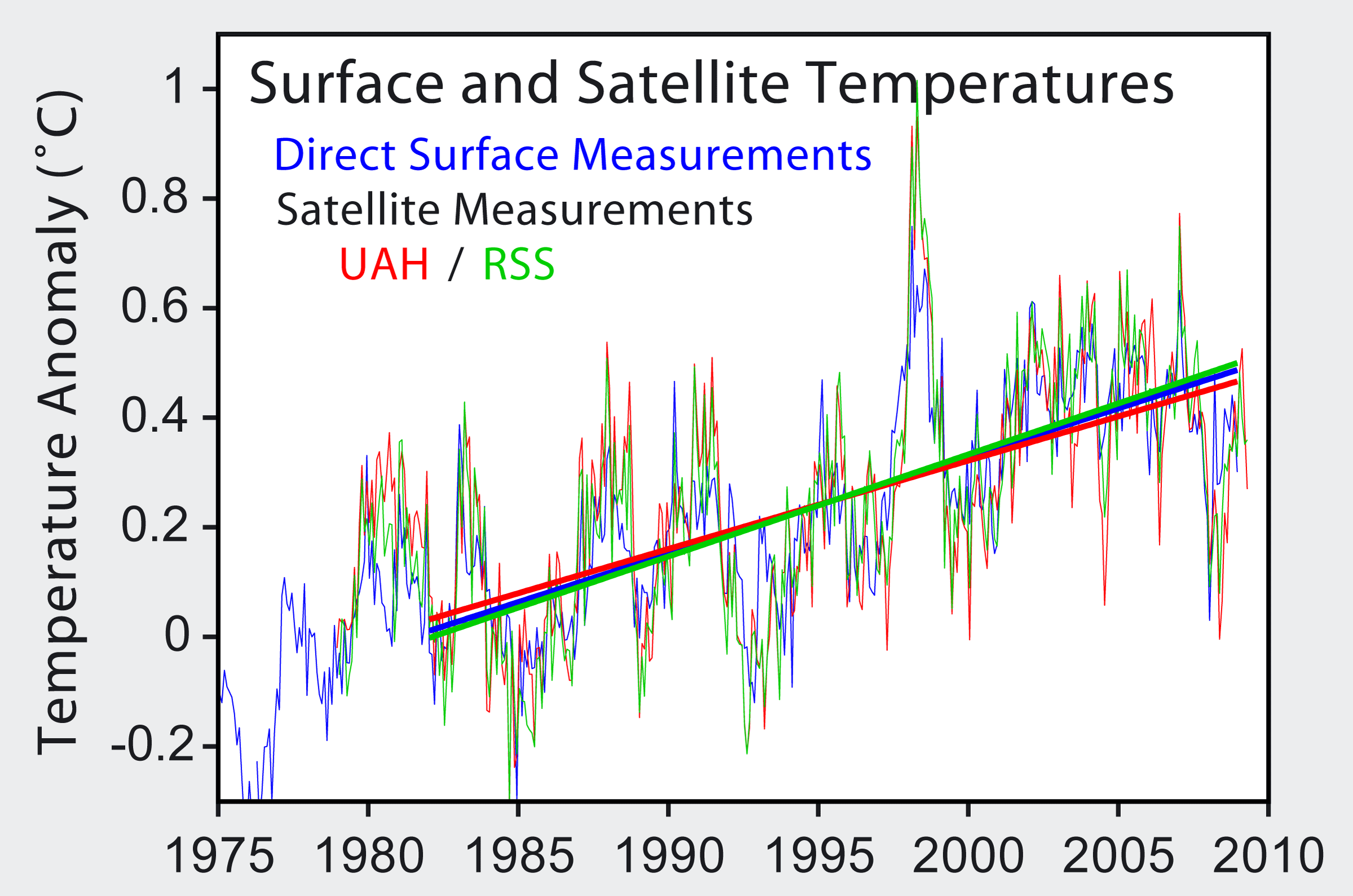
It seems pretty clear that the models forecast a steady upward trend in global temperatures as long as carbon dioxide levels rise. (Which they have). Yet according to satellite and surface temperature measurements the global average temperature has essentially remained flat for the last 12 years. This strikes me as somewhat curious.


When An Inconvenient Truth came out I believed the movie to be scientifically accurate. Carbon dioxide levels were rising and so were temperatures. And hurricane activity, especially after the disastrous 2005 season, was out of control.

But a funny thing happened on the way to the end of the world: hurricane activity on the global scale is near historical lows. And the Earth seems to have, at least temporarily, stopped warming.

This, despite the fact that some of the country’s leading climate scientists say there is unequivocally a link between major hurricanes and climate change. And despite the fact that other leading climate scientists predicted 2009 or 2010 will go down as the warmest year in recorded history. Either prediction, if true, would be alarming.

Yet both of these predictions seem, at the present moment, to be off.

Then there’s this: a revealing story from an international meeting of climate scientists where a German climate scientist says the world may cool for the next decade or two. New Scientist reports:

One of the world’s top climate modelers said Thursday we could be about to enter “one or even two decades during which temperatures cool.

“People will say this is global warming disappearing,” he told more than 1500 of the world’s top climate scientists gathering in Geneva at the UN’s World Climate Conference.

“I am not one of the skeptics,” insisted Mojib Latif of the Leibniz Institute of Marine Sciences at Kiel University, Germany. “However, we have to ask the nasty questions ourselves or other people will do it.”

Few climate scientists go as far as Latif, an author for the Intergovernmental Panel on Climate Change. But more and more agree that the short-term prognosis for climate change is much less certain than once thought.

If we can’t have confidence in the short-term prognosis for climate change, how can we have full confidence in the long-term prognosis?

The article is significant for a couple of reasons. First of all it’s written by Fred Pearce, who has a history of forceful journalism outlining climate change’s perils, and it’s published by New Scientist, which has long advocated vigorous action to curb climate change. I respect both the author and the publication.

Secondly, the key point here is that scientists are acknowledging that natural variations are playing a very important role in our present and future climate, perhaps cooling it. Therefore it stands to reason that natural variations might also have played a role in the temperature run-up of the 20th century.

Do not misunderstand me. I am not a climate change skeptic. I do not deny that the planet warmed 0.6°C in the 20th century. I do not deny that humans played some part in that significant warming.

But I am confused. Four years ago this all seemed like a fait accompli. Humans were unquestionably warming the climate and changing the planet forever through their emissions of carbon dioxide.

The problem is that some climate scientists and environmentalists have been so determined to see something done about carbon dioxide emissions — now — that they have glossed over the uncertainties.

Uncertainties like: maybe there isn’t a linear relationship between carbon dioxide and temperature, and maybe the planet will cool for a couple of decades even as carbon dioxide emissions accelerate.

For the last few years some scientists and environmentalists have been telling us a lot about what “will” happen in the future if carbon dioxide emissions continue unabated. It perhaps would have been a lot better if they talked about what “may” happen.
***
Robert L. Bradley, Jr. is CEO and founder of the Institute for Energy Research; an adjunct scholar of the Cato Institute and the Competitive Enterprise Institute in Washington, D.C.; and a visiting fellow of the Institute of Economic Affairs in London. Bradley is also a senior research fellow of the Center for Energy Economics at the University of Texas at Austin, among other honorary affiliations.

Sunday, March 8, 2009

International Conference on Climate Change Preview

With the Second Annual International Conference on Climate Change coming up in New York City this week a couple of our regular contributors have written commentary on global warming. We offer their insights to you here.

The first, from Paul Driessen, is more opinion, focused on the energy consumers. Paul says, “Having followed and participated in the global warming debate for nearly 15 years now, I’ve become convinced that the conduct of climate alarmists closely resemble consumer fraud, in the form of classic bait-and-switch tactics. My article makes a compelling case that this is indeed happening--and presents important facts that voters should keep in the forefront, as Congress and EPA attempt to implement punitive and expensive carbon dioxide reduction schemes. It also highlights the 2009 International Conference on Climate Change that will be held in New York, beginning tomorrow.”

The next posting is more scientific in style and is from Dennis Avery—one of our regular contributors and, like Paul, Dennis will be one of the presenters at the International Conference on Climate Change.


Global Warming “Bait-And-Switch:” Scientific “Consensus” And Other Shady Sales Tactics Promote Alarmist Theories
Fred Schwindel’s TV City ad promises 40” flat screen televisions for $200. You rush to his store, to learn he’s “fresh out” --but has some 42” models for $1000.

That’s “bait-and-switch,” and Fred could be prosecuted for consumer fraud.

In the political arena, however, bait-and-switch is often rewarded, not punished--especially in the case of global warming alarmism. Instead of fines or jail time, politicos get committee chairs, presidencies, speaking fees and Nobel Prizes. Scientists and bureaucrats receive paychecks, research grants and travel stipends for Bali. Activists get secretive government payments for “public education” campaigns. Companies get government contracts, subsidies and seats at the bargaining table. And all are lionized or canonized for supporting Climageddon theories and policies.

Global warming bait-and-switch starts with simple statements that few would contest--then shifts seamlessly to claims that are hotly disputed and supported by little or no evidence.

The bait: Global warming is real. The switch: Global warming is intensifying and threatens agriculture, human civilization and the fabric of life everywhere on earth.

Bait: 99% of scientists agree on the presence of human-caused global warming. Switch: The debate is over. Humans are the primary cause of temperature increases.

Bait: Atmospheric carbon dioxide from human activities is increasing. Switch: CO2 is the dominant greenhouse gas and is reaching unprecedented and dangerous levels.

Bait: Earth warmed during the twentieth century, as CO2 levels increased. Switch: Runaway warming is increasing hurricanes, melting polar ice caps, raising sea levels and causing species extinction.

Bait: Even little things like reducing personal energy consumption help the environment. Switch: We can stop climate change by switching to wind and solar energy.

The perpetrators of these B/S schemes may never be chastened or prosecuted. However, as in the case of consumer fraud, an informed public is less likely to get fleeced.

President Obama and congressional Democrats support a $650 billion carbon cap-and-trade tax on every household, business and factory in America. If they introduce legislation amid this recession, voters, energy consumers and more responsible legislators should keep important facts in mind.

Global warming (aka climate change) has been “real” since time began. Witness the Ice Ages, interglacial periods, Medieval Warm Period (950-1350), Little Ice Age (1400-1850), Anesazi drought, Dust Bowl, and conversion of verdant river valleys into the Sahara Desert some 4,000 years ago.

No one yet knows what solar energy fluctuations, planetary orbit shifts, recurrent oscillations in ocean currents, cloud cover variation and other natural forces combined to cause these potent climatic changes. But there is no evidence that they have suddenly been displaced by human CO2 emissions.

Growing numbers of scientists say the climate change debate is far from over, and global warming was never a crisis. Over 650 certified meteorologists and climate scientists are on a US Senate compilation of climate cataclysm skeptics--and 32,000 scientists have signed the Oregon Petition, saying they dispute claims that humans are causing climate change, and the changes will be disastrous.

Many of them are meeting in New York March 8-10, at the 2009 International Conference on Climate Change. They may not drive the final nails into the coffin of climate hysteria, but their findings and analyses underscore the lack of evidence for scary “forecasts” that are routinely generated by woefully inadequate computer models and self-interested researchers, activists and politicians. They will point out that planetary temperatures are no longer rising, hurricanes are not increasing in number or intensity, ice caps are not disappearing, and moderate temperature and CO2 increases benefit plant growth.

The UN’s Intergovermental Panel on Climate Change claims to be the world’s “most authoritative body” on the subject. However, only “something on the order of 20%” of the panel’s scientists “have some dealing with climate,” admits a senior member. Even the IPCC chairman is an economist, not a scientist.

Worse, says atmospheric scientist Dr. Roy Spencer, the IPCC insists that human carbon dioxide emissions drive global warming. It has “never seriously investigated” the possibility that climate change might be natural. The IPCC sees only what it is looking for; it sees nothing it is not looking for.

Atmospheric carbon dioxide levels may have “soared” from 280 ppm to 385 ppm over the last century. But this represents an almost trivial rise from 0.03% of the atmosphere to 0.04% – the equivalent of an increase from 3 cents to 4 out of $100, or from 1.08 inches to 1.44 inches on a football field. The dominant greenhouse gas is water vapor, which nature controls via evaporation and precipitation.

Planetary temperatures may have increased during the last century, as CO2 levels increased. But not in a straight line. They rose 1900-1940 (1934 was the century’s warmest year), fell 1940-1975, rose again 1975-1998, then stabilized and even declined slightly from 1998 to 2008.

New York, Holland and Bangladesh might be inundated by a 49-foot rise in sea level, if the entire West Antarctic ice sheet melted. But that would require a global temperature spike far greater than even Al Gore has prophesied. The average temperature for the peninsula’s two-month summer is barely 36 F; in the winter, temperatures are below minus 50.

Unplugging unused appliances and switching to CFL bulbs may help jet-setting Hollywood celebrities feel better. But they will not stabilize Earth’s climate. Even grounding Al Gore and John Travolta’s private jets, scrapping every US automobile, mothballing America’s coal-fired power plants, and slashing US CO2 emissions by 80% (back to 1905 levels), as President Obama wants to do, will have little effect.

Even the IPCC recognizes that perfect compliance with the Kyoto Protocol by every country would reduce global temperature increases by only 0.2 degrees by 2050 (assuming CO2 does drive global warming). But Europe has put its greenhouse gas reduction programs on hold. Australia is poised to reject cap-and-trade plans. China and India are building new coal-fired power plants every week.

Nearly 85% of US energy is hydrocarbon based, whereas wind turbines currently provide 0.5% and generate electricity only 25% of the time. Even absent the deepening recession, taxing and penalizing hydrocarbon use and CO2 emissions will drive up energy costs and extinguish far more jobs than can possibly be created via government-subsidized renewable energy and green-collar job initiatives. The impacts on poor families, economic civil rights, living standards and civil liberties would be severe.

Not surprisingly, the more people understand these facts, the worse the hysteria gets. Al Gore: Soaring global temperatures will “bring human civilization to a screeching halt.” Energy Secretary Stephen Chu: “We’re looking at a scenario where there’s no more agriculture in California.” NOAA scientist Susan Solomon: “In ten years the oceans will be toxic, and all life in them will die.” NASA astronomer James Hansen: “Death trains” are carrying poisonous fuel to “coal-fired factories of death.”

Hollywood horror movie writers couldn’t possibly top this stuff.

So when Congress and the President call for more economic pain through energy restrictions and cap-and-trade bills, demand solid evidence for catastrophic warming and human causation. Don’t accept worthless computer models and worst-case scenarios. And don’t be conned by bait-and-switch tactics.

Paul Driessen is senior policy advisor for the Committee For A Constructive Tomorrow (http://www.cfact.org/) and author of Eco-Imperialism: Green power – black death.


Natural Global Warmings Have Become More Moderate
This week, at the 2nd international conference of man-made warming skeptics sponsored by the Heartland Institute in New York, I’ll predict the earth’s warming/cooling trends for the 21st century.

I will be among splendid company such as John Coleman, founder of the weather channel, Ross McKitrick, who debunked the “hockey stick” study, physicist Willie Soon, and many other presenters with brilliant credentials. A thousand scientists, economists, and skeptics from every walk of life will meet to discuss the current climate indicators.

I’ll use physical evidence of the more than 500 warmings in the past million years, which are found worldwide in ice cores, seabed sediments, fossil pollen and cave stalagmites. At least 700 scientists have published evidence on these solar-driven Dansgaared-Oeschger cycles. The good news is that the D-O cycle’s warmings have been getting somewhat cooler for the past 10,000 years—and there is no evidence that human-emitted CO2 will make them much warmer.

This means that the Modern Warming will probably remain cooler than the Medieval Warming (950-1300). It was 0.3 degrees warmer than the 20th century based on Craig Loehle’s study of 2000 years of temperature proxies. Willi Dansgaard’s 10,000-year reconstruction from ice cores shows the Roman Warming as warmer than the Medieval—but the two Holocene Warmings centered on 4,000 and 7,000 years ago were lots warmer than either.

The IPCC rejects the cycle evidence. They have concluded that the variability of the sun is “too small” to account for the earth’s recent warming 1976-98. They want us to sacrifice trillions of dollars to displace fossil fuels based on computers that couldn’t even predict the current cooling.

In contrast, I’ll predict a cooling planet for the next 25-30 years, because of the D-O cycle’s solar linkage. The sunspots began predicting cooling back in 2000, and it arrived a bit early, in 2007. CO2’s correlation with our temperatures over the past 150 years is only 22 percent. The correlation with sunspots is 79 percent—What does the UN think caused the 500 previous D-O cycles in the ice cores and seabed records?

There’s more. NASA, bless their hearts, reported last April that their Jason satellite confirms a cooling shift in the Pacific, our biggest heat sink. Roseanne D’Arrigo’s tree ring and rainfall proxies from around the Pacific Rim tell us that the earth’s temperatures have mirrored the Pacific’s cyclical shifts—in 25-40 year spurts—for at least the past 400 years.

I predict that after the current Pacific cooling is over, the earth will resume getting slowly and erratically warmer. But not much warmer. That’s because the D-O cycles are typically abrupt, delivering about half their temperature increase in the first few decades. Remember, we’ve had no significant net warming since 1940.

If the moderating trend in the global warming cycles persists, then we will get less than 0.5 degree C more warming over the next two centuries. If the Greenhouse Theory has any validity, we might get a bit more than 0.5 degree more warming—but not much. We tend to forget that the climate forcing power of CO2 unquestionably declines logarithmically, so the earth has probably already gotten three-fourths of the total.

As the earth cools, the U.S. will use our new natural gas surplus instead of biofuels, carbon taxes will die and the deliberate disruption of the economy will be stifled. Further warming 40 years from now will be too mild and erratic to renew public panic. Environmental assessments will become more realistic—and useful.

Dennis T. Avery is an environmental economist, and a senior fellow for the Hudson Institute in Washington, DC. He was formerly a senior analyst for the Department of State. He is co-author, with S. Fred Singer, of Unstoppable Global Warming Every 1500 Hundred Years, Readers may write him at PO Box 202, Churchville, VA 24421 or email to cgfi@hughes.net.